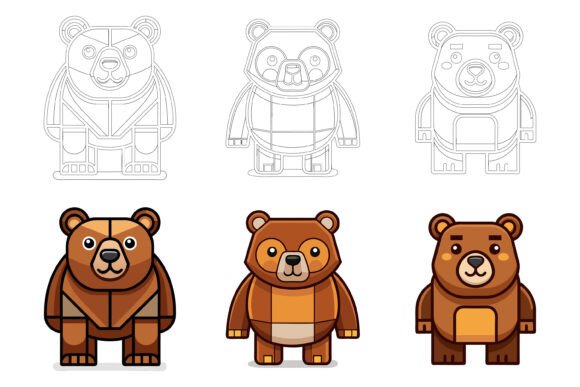
Cute Bears and the Rise of Emotionally Intelligent Illustration in Modern Design
In a digital landscape saturated with generic stock imagery, Cute Bears represent something far more valuable than simple graphics. They embody a strategic shift toward illustrations that communicate warmth, approachability, and emotional resonance. For professionals across marketing, product development, and content creation, the decision to incorporate carefully crafted visual assets has moved from aesthetic preference to business necessity. The AI EPS illustration sets that have emerged around themes like these friendly characters are not just collections of files; they are toolkits for building deeper audience connections in an increasingly impersonal digital world.
What makes these particular illustration collections noteworthy is the convergence of artistic sensitivity and technical precision. When you encounter a well-structured AI EPS file set, you are looking at the result of deliberate choices made by designers who understand both the emotional weight of visual storytelling and the practical demands of modern creative workflows. The cute bear motif, far from being a niche preference, taps into universal patterns of human psychology that influence how people perceive brands, products, and messages.
Why Cute Bears Have Become a Strategic Visual Language
The appeal of Cute Bears in professional illustration goes beyond superficial charm. Across industries, organizations are recognizing that approachable, character-driven visuals reduce the psychological distance between a brand and its audience. In fields as varied as healthcare communication, educational technology, financial services, and consumer packaged goods, the integration of warm, animal-inspired illustration has measurable effects on engagement metrics. A user encountering a friendly illustrated character on an onboarding screen, for example, experiences lower cognitive resistance and higher information retention compared to purely abstract or text-heavy interfaces.
This shift reflects a broader understanding that consumers no longer separate emotional experience from functional utility. The same person who researches product specifications carefully also responds to visual cues that signal trustworthiness and empathy. Cute Bears as a design element function as a kind of emotional shorthand, instantly communicating values like safety, reliability, and playfulness without requiring explicit statements. For startups building brand identities and established companies refreshing their visual presence, this makes character-based illustration a remarkably efficient communication tool.
The Psychology Behind Character-Driven Illustration
Researchers in visual cognition have long observed that human brains process faces and face-like patterns with exceptional speed and depth. The inclusion of expressive characters in design leverages this neural priority, directing viewer attention and creating micro-moments of emotional engagement that abstract shapes rarely achieve. When a brand incorporates Cute Bears into its materials, it is essentially borrowing from millions of years of evolutionary programming that makes humans respond to nurturing, approachable faces. The effectiveness of this approach is amplified when the illustrations maintain consistency in expression, proportion, and stylistic treatment across all applications.
The Professional's Perspective: What Separates Quality Illustration Resources
For designers, art directors, and creative entrepreneurs, the conversation around illustration sets quickly moves from conceptual appreciation to practical evaluation. The distinction between a usable asset and a frustrating one lies in how thoughtfully the files are prepared. A collection that includes AI EPS and JPG formats immediately signals an understanding of different production environments. The vector formats preserve infinite scalability for print work, signage, and high-resolution displays, while raster versions provide quick access for web prototypes, social media, and presentations.
More revealing still is the organizational logic embedded in the file structure. When layers are named meaningfully and grouped in ways that reflect the illustrator's own creative process, the end user inherits a mental model that makes customization intuitive. Instead of spending precious project time decoding a tangled hierarchy of unnamed paths and masks, designers can locate exactly the elements they need, whether they want to recolor a specific character, extract a particular expression, or reposition components for a new composition.
Cross-Platform Compatibility as a Professional Standard
The explicit attention to both Mac and Windows users in the collection's design speaks to an often overlooked aspect of creative resource development. Different operating systems handle font rendering, color profiles, and file paths in subtly different ways. An illustration set that has been tested and structured for both environments reduces the friction that can derail collaborative projects where team members operate on different platforms. This consideration reflects a maturity in the resource's development that goes beyond the visual appeal of the artwork itself.
Workflow Integration and the Demand for Editable Intelligence
Modern creative work is characterized by rapid iteration and the constant pressure to adapt existing assets to new contexts. The most valuable illustration resources are those that treat editability not as an afterthought but as a foundational design principle. When a collection of Cute Bears comes with neatly organized files and layer structures, it signals that the creator anticipated the user's need to modify, combine, and repurpose elements. A well-layered file allows a designer to isolate a character from its background, apply a new color palette that matches a brand's guidelines, or scale individual features for different aspect ratios without degrading quality.
This prioritization of editability aligns with the broader industry movement toward design systems and component-based thinking. Just as interface designers build reusable UI components, illustration collections that are structured as modular, editable systems provide building blocks that can be reconfigured across multiple projects. A single well-organized file of Cute Bears can supply assets for a website hero image, an app icon set, printed marketing collateral, and social media templates, all while maintaining visual coherence.
The Precision Imperative in Professional Illustration
The quality of details and consistency that a professional illustration set demonstrates becomes apparent not in a single isolated use but across repeated applications. Inconsistencies in stroke weights, color values, or character proportions accumulate over a project lifecycle, creating visual friction that audiences may not consciously identify but will subconsciously perceive as lower quality. Collections that maintain rigorous consistency allow brands to build recognition gradually, reinforcing visual identity through repeated exposure to harmonious elements.
Multi-Application Versatility as a Competitive Advantage
The stated suitability of these illustrations for print, web, symbols, apps, and infographics is not merely a feature list but a description of modern multimedia reality. Today's creative professionals rarely work within a single medium. A campaign conceived for social media must adapt to email, to physical display advertising, to app interfaces, and to presentation decks. Each context imposes different technical requirements and viewing distances. Vector-based illustration sets answer this multiplicity of demands with a single, consistent source of truth that can be exported at any resolution and in any color space.
For entrepreneurs and small teams without dedicated illustration departments, this versatility translates directly into resource efficiency. A single investment in a comprehensive AI EPS collection can serve needs that would otherwise require multiple asset purchases or costly custom illustration work. The ability to change colors and modify icons easily according to needs further extends this value, as the same core illustrations can be adapted for seasonal campaigns, product line extensions, or entirely new brand directions without starting from scratch.
Design for Information and Emotional Communication
Infographics represent a particularly compelling use case for character-driven illustration. Data visualization has evolved beyond sterile charts and graphs to incorporate narrative elements that guide viewers through complex information. A thoughtfully placed Cute Bear illustration within an infographic can serve as a visual anchor, drawing attention to key data points and creating emotional stakes that make statistics memorable. In educational contexts, the same technique transforms abstract concepts into relatable scenarios, lowering the barrier to understanding for diverse audiences.
The Broader Context: Why Illustration Matter Now
The growing attention around AI EPS illustration collections featuring charming, character-focused themes reflects larger currents in technology and culture. As artificial intelligence transforms content creation, the value of carefully crafted, human-centered illustration that conveys specific emotional tones has increased rather than diminished. Generic, mass-produced visuals are easier to create than ever, which paradoxically makes distinctive, well-structured illustration resources more strategically valuable for those seeking differentiation.
Simultaneously, the expansion of remote work and global collaboration has intensified the need for visual communication that transcends language barriers. A universally recognizable expression rendered through a Cute Bear character communicates across linguistic divides in ways that text alone cannot match. For organizations serving international audiences, this visual universality offers practical advantages in creating cohesive brand experiences across markets with different languages and cultural contexts.
Investment in Creative Resources as Strategic Decision-Making
When professionals evaluate illustration resources like the Cute Bears AI EPS collection, the calculus extends beyond immediate project needs. The decision reflects an understanding that visual assets are infrastructure, not consumables. Just as a well-organized code library pays dividends across multiple development cycles, a versatile, expertly structured illustration set accumulates value with each reuse and adaptation. Forward-thinking creatives and business owners recognize that the time saved through efficient file organization and the brand equity built through consistent, emotionally resonant visuals compound into meaningful competitive advantages over months and years of operation.
The invitation to buy now and start using these illustrations is ultimately an invitation to invest in a creative resource that aligns with how modern work actually happens: iteratively, collaboratively, and across an ever-expanding array of contexts and formats. For the professional who understands that every visual touchpoint shapes audience perception, the choice of illustration partner becomes anything but trivial.