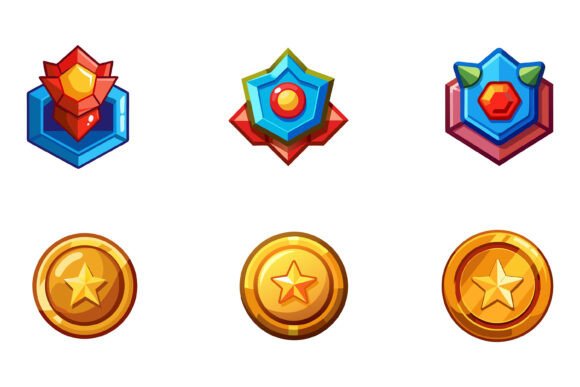
The Art and Utility of Game Level Rank Badges in Modern Visual Communication
In digital and physical spaces alike, humans have an innate desire to recognize progression, skill, and status. Game level rank badges have become one of the most effective shorthand visual tools for communicating hierarchy, achievement, and identity. From competitive gaming leaderboards to corporate training platforms, these small but powerful icons convey complex information instantly. Their design, psychology, and application extend far beyond entertainment, making them a fascinating subject for designers, educators, business owners, and hobbyists alike.
How Game Level Rank Badges Evolved From Simple Icons to Visual Language
The concept of rank badges isn't new. Militaries, guilds, and scouting organizations have used insignia for centuries. Video games codified this into a digital language, starting with arcade high-score screens and evolving into the elaborate tier systems seen in modern multiplayer titles. Early rank icons were often pixelated stars, shields, or chevrons, limited by screen resolution. As graphics advanced, so did the complexity and artistry of these badges. Today, a bronze, silver, gold, platinum, diamond, and master hierarchy is almost universally understood, even by people who don’t play games.
Game level rank badges serve multiple roles: they motivate players to keep engaging with content, they signal expertise to teammates and opponents, and they create a sense of belonging within a community. A well-designed badge tells a story without words. The transition from a novice emblem to an elite crest becomes a personal narrative that strengthens user commitment. This visual vocabulary has migrated into apps, fitness trackers, loyalty programs, and e-learning platforms, proving that the underlying principles are universally applicable.
The Psychology That Makes Rank Badges Irresistible
Why do we care so much about a small icon next to our username? Behavioral psychology points to several factors. First, goal-gradient effect suggests that people work harder as they get closer to a reward. Seeing a partially filled progress bar or a badge that sparkles just out of reach drives continued effort. Second, social comparison theory plays a role: rank badges provide an immediate, visible marker of where someone stands relative to others. This can foster healthy competition or, in some cases, status anxiety. Third, endowment effect makes users value their earned badges more than ones that are freely given. The act of achieving a rank creates ownership.
Designers leverage these psychological triggers by carefully designing tier systems. A common structure uses between five and eight levels, often named with aspirational metals or gemstones. The visual distinction between tiers must be clear but also give a sense of escalation. Color gradients from warm grays to brilliant golds, or from simple shapes to ornate frames, help the brain intuitively grasp the hierarchy. Game level rank badges are not just decorative; they are tiny behavioral engines.
Key Design Characteristics of Effective Game Level Rank Badges
Creating a rank badge that resonates requires attention to several attributes. These characteristics are equally important whether you are designing for a video game, a corporate wellness app, or a classroom reward system.
- Shape and Silhouette: The outer contour is the first thing noticed. Shields, circles, hexagons, and winged crests each carry different connotations. Shields imply protection, military precision, or competitive spirit. Circles feel more approachable and community-oriented. Hexagons suggest science, strategy, or modern tech. A unique silhouette helps a badge stand out at small sizes.
- Color Palette: Color psychology is critical. Bronze, silver, gold, and platinum are classic tier indicators because they align with real-world value perceptions. Adding cool blues or purples for higher tiers can suggest mystical or elite status. The color should remain vibrant when scaled down to 24x24 pixels, which is a common display size.
- Iconography: The central symbol often reflects the context. A gaming badge might use swords, stars, or animal heads. A fitness app might use flames, leaves, or wings. The symbol should be simple enough to be recognizable even without the surrounding ornamentation. Icons that are too detailed can become muddy.
- Typography and Numerals: Some badges incorporate numbers or roman numerals to indicate level. The typeface needs to align with the badge’s style—serif fonts for tradition, sans-serif for modernity. Consistency across a set is vital so the user instantly recognizes the family relationship.
- Ornamental Framing: Laurels, wings, gears, and ribbons can amplify perceived value. Higher tiers often feature more elaborate framing, creating a clear visual escalation. This is where many design resources become invaluable, saving hours of detailed vector work.
Getting these elements to harmonize is a craft. It requires not just artistic skill but an understanding of the context in which the badge will live. A badge that looks stunning at 512x512 pixels may fail as a tiny sidebar element. Designers must test their work at various scales and on different backgrounds.
Beyond Gaming: Where Rank Badges Create Real-World Value
The versatility of game level rank badges has led to their adoption across numerous industries. Understanding these use cases can inspire new applications.
Education and E-Learning Platforms
Gamified learning management systems use badges to reward course completion, quiz mastery, and participation. A digital “Ace Participant” badge or a “Grammar Guru” emblem motivates students to engage more deeply. Unlike traditional grades, badges feel less punitive and more aspirational. They can be displayed on student profiles, fostering pride and peer recognition. Educators report increased voluntary assignment submissions when a badge system is thoughtfully implemented.
Corporate Training and Skill Development
Enterprises deploy rank badges in onboarding programs, compliance training, and professional development tracks. Earning a “Leadership Level 3” badge after completing certain modules and assessments turns mandatory training into a visible career asset. Some companies integrate badges with HR systems, allowing employees to showcase them in internal directories. This not only motivates individual growth but also helps managers quickly identify subject matter experts within the organization.
Fitness and Wellness Applications
Step challenges, workout streaks, and mindfulness goals are often recognized with tiered icons. A runner might progress from a “Sneaker Starter” badge to a “Marathon Legend” crest, with increasingly dynamic designs. These visual rewards reinforce habit formation and provide a sense of community when shared on social leaderboards. The design of fitness badges often emphasizes energy, movement, and health through vibrant colors and dynamic shapes.
Loyalty Programs and E-Commerce
Many brands now move beyond simple point accumulation to tiered status badges. A coffee shop app might show a bronze, silver, or gold cup icon next to a user’s name. These badges publicly affirm loyalty and can even influence social status among customers. The psychological drive to “level up” can increase purchase frequency without traditional discounting. A well-designed badge feels like a reward in itself.
Online Communities and Content Platforms
Forums, Discord servers, and content platforms use rank badges to denote moderators, top contributors, verified creators, and tenure. These icons build trust and help new members navigate the community. A “Top 1% Commenter” badge encourages quality participation and reduces toxic behavior because users want to protect their visible status.
Across all these domains, the visual asset used for the badge directly affects its perceived worth. A cheap-looking clipart badge may diminish the sense of achievement rather than enhance it. This is why high-quality illustration resources are so valuable to designers and non-designers alike.
The Value of Ready-Made Illustrations for Badge Projects
Not every project has the budget or timeline to commission custom badge sets from a graphic designer. This is where carefully curated illustration collections become a game-changer. A professional set of AI EPS illustrations, specifically designed with tier systems and rank recognition in mind, provides immediate, editable building blocks. You gain access to vector files that can be scaled infinitely without quality loss, and since they come in AI EPS and JPG formats, they are compatible with both Mac and Windows environments.
When working with such a collection, the ability to edit colors, modify individual elements, and rearrange layers is crucial. The best sets are organized with a clear file and layer structure, so you can isolate a specific laurel wreath, change a shield’s hue, or swap out an icon in seconds. This adaptability means the same base set can be tailored for a gritty competitive shooter, a cheerful fitness app, or a professional learning portal. Consistency in detail and proportion across the entire set ensures your badges look like a family, not a mismatched assembly.
Consider the practical workflow. You might start with a base badge from a library, ungroup the vector components, adjust the gradient from gold to a steel blue for your highest tier, add a custom numeral, and export the result as PNGs for your app. Later, you can extract the same badge and use it on printable certificates or promotional flyers, maintaining perfect fidelity because the original is vector. This flexibility is especially important for projects that span both digital and print media, such as an educational platform with downloadable award certificates.
The detail work—highlights, shadows, subtle textures—is often what separates a generic icon from a badge that feels truly premium. A well-produced illustration set will have these nuances baked in, and because the files are neatly organized, you can deepen or soften them with ease. For a small business owner without design experience, being able to change a single color or add a company logo to a pre-made badge can be the difference between a generic-looking reward system and a branded experience.
Such resources also serve as excellent learning tools for novice designers. By examining how an expert constructed a multi-layered badge—the use of opacity, the placement of highlight shapes, the way gradients create metallic effects—you can reverse-engineer techniques and apply them to original work. The combination of AI EPS source files and JPG previews allows for both deep editing and quick reference.
Practical Guidance for Choosing and Customizing Badge Assets
If you decide to use a ready-made illustration collection, a few considerations will help you get the most value. First, verify that the file types meet your needs. AI EPS files are editable in Adobe Illustrator and many other vector graphics programs, which preserve layers and editability. JPG versions provide a quick raster reference. Ensure the set includes a license that covers your intended use, especially for commercial applications.
Second, examine the layer structure. A file that is flattened or poorly organized will make customization frustrating. Look for resources that keep background, frame, icon, and text on separate, clearly named layers. This organization allows you to quickly isolate and modify components.
Third, assess the range of badges in the set. A truly robust collection will offer variations across tiers, from very simple beginner styles to elaborate master-ranked emblems. Having 10 or more distinct base designs that can be recolored and remixed gives you enormous creative range without the need to build everything from scratch.
Finally, test the editing process yourself. Open an AI EPS file, select a shape, and change its fill color. If this feels intuitive and the result looks clean, the asset quality is high. The true power of such collections lies in how effortlessly you can make the design your own, adapting it to your brand palette or the thematic needs of your project.
Why Cohesive Visual Identity Matters in Progression Systems
When users interact with a rank system, they unconsciously evaluate its professionalism based on the visual design. Sloppy, inconsistent, or overly generic badges can make the entire progression feel cheap, reducing motivation. Conversely, a cohesive set of badges conveys that the organization values the user’s effort. It signals that the achievement is worthy of a carefully crafted emblem, not an afterthought. This is true whether the badge appears next to a teenager’s gaming avatar or a senior executive’s internal training profile.
Consistency also aids comprehension. If a bronze badge uses a circular frame and a star icon, the silver should follow the same framework but with added complexity or brighter color. The brain will quickly map the visual pattern to the rank order. Sudden, illogical shifts in design break this mapping and can confuse users. A well-built illustration set that was designed as a complete series inherently preserves this visual logic, which is why many organizations prefer them over assembling disparate free icons.
Ultimately, game level rank badges have grown from niche game mechanics into a ubiquitous design element that shapes behavior across society. Understanding their history, psychology, and design principles equips you to use them effectively, whether you are coding a new app, gamifying a classroom, or rewarding customer loyalty. When you need high-quality, versatile, and editable source files to bring those systems to life, comprehensive AI EPS collections—compatible with Mac and Windows, meticulously layered, and brimming with detail—offer a practical path from concept to polished reality. The time saved on illustration can be redirected into refining the user experience, testing engagement strategies, and delighting your audience with a visual language that feels both familiar and fresh.