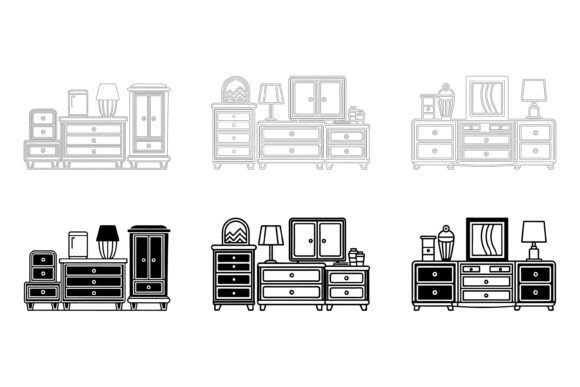
Transform Your Living Room Visuals with Professional AI EPS Illustrations
When you think about a Living Room illustration, you might picture a generic sofa and a coffee table. But the right visual asset does more than fill empty space on a webpage or presentation slide. It communicates comfort, lifestyle, and belonging. Our AI EPS illustration collection focuses on the Living Room as both a physical space and a visual metaphor for connection, relaxation, and thoughtful design. What makes these files genuinely useful is not just the artwork itself but the strategic advantage of having fully editable, impeccably organized vector assets ready to adapt to your specific project requirements.
Why Vector Format Changes How You Use Living Room Graphics
Raster images lock you into one resolution, one color palette, and one composition. The moment you need to resize for a billboard or recolor for a brand refresh, you face quality loss or hours of manual editing. This collection delivers AI EPS files along with JPG previews, giving you the best of both worlds. The native vector format means every element inside a Living Room scene—the texture on a throw pillow, the arc of a floor lamp, the grain of a wooden floor—remains crisp at any scale.
For Mac and Windows users alike, compatibility is seamless. You open the file in Adobe Illustrator, Affinity Designer, CorelDRAW, or any EPS-compatible application and find a neatly organized layer structure. No flattening, no grouped messes, no mystery clipping masks. The designer has named layers logically, grouped related objects, and structured each Living Room illustration so you can isolate, modify, or remove components without hunting through hundreds of unnamed paths.
Strategic Applications Beyond Basic Decoration
Most people download illustrations and place them as static decoration. That works, but it underuses the asset. Consider the Living Room scenes in this collection as modular storytelling components. An interior designer might extract individual furniture pieces to build a service catalog. A real estate marketer might recolor wall tones to match local market preferences. A SaaS company building a home management app might use these illustrations as onboarding screens, swapping room elements to reflect user inputs.
The strategic value lies in the adaptability. When a file includes well-structured AI EPS formats, you are not buying a picture—you are buying a toolkit. You can change colors, modify shapes, rearrange compositions, and export slices for different platforms. This matters especially for Living Room concepts because residential spaces carry emotional weight. The difference between a cold, sterile room and a warm, inviting one often comes down to small details like lighting temperature, textile patterns, and spatial proportions. You control all of these variables.
Planning Your Visual Workflow Around Editable Assets
Before you start pulling illustrations into your project, map out where Living Room visuals will appear and what job each instance needs to do. A blog post about home organization might need a detailed scene with callout areas. A landing page for a furniture retailer might need isolated product silhouettes that match the brand aesthetic. An infographic about energy efficiency might need simplified room layouts with highlighted zones.
Here is a practical planning sequence you can follow:
- Identify the primary goal: Are you informing, selling, onboarding, or building brand identity? The answer determines how prominently the Living Room visuals should appear.
- Define the emotional tone: A family-focused Living Room needs softer lines and warmer tones. A tech-focused smart home context might call for cleaner geometry and cooler hues.
- Map touchpoints: List every place the illustration will live—website hero section, email header, social media graphic, printed brochure, app interface. Each touchpoint may require different cropping, resolution, or color treatment.
- Set adaptation rules: Decide which elements stay consistent across all uses and which can change. Consistency builds recognition; flexibility prevents visual fatigue.
Because these files are organized by layer and group, you can execute this plan quickly. You are not starting from scratch each time you need a variant. You duplicate the master file, make targeted edits, and export.
How Perfection in Details Supports Credibility
Audiences are visually literate. They may not consciously notice a misaligned shadow or an inconsistent perspective, but these imperfections erode trust. The Living Room illustrations in this collection prioritize detail consistency. Shadows fall from a unified light source. Proportions between objects make sense. Textures and patterns follow realistic scale. When you use such assets in client-facing work, the underlying quality communicates professionalism.
This is especially true for industries where visual precision directly impacts perceived value. An architect presenting concept renderings, a furniture brand showcasing seasonal collections, or a hospitality business marketing vacation rentals—each relies on Living Room visuals that feel authentic rather than cartoonish or sloppy. The editable nature of these files also means you can audit details yourself. Zoom into a lampshade gradient, check the curvature on a sofa arm, adjust the opacity on a window reflection. Nothing is baked in permanently.
Making Edits Without Technical Friction
Perhaps the most practical advantage of this collection is the ease of modification. Many illustration packs technically allow editing, but the process is painful. You inherit dozens of clipping masks, unnamed groups, and inexplicable compound paths. Changing a simple wall color can become a 20-minute puzzle. Here, the file structure is designed for quick access. You click into a labeled layer, select the object, and change fill or stroke. That straightforward workflow matters when you are iterating rapidly or when multiple team members need to work with the same asset.
Consider a scenario where a marketing team prepares a campaign across three regional markets. Each region wants the Living Room scenes to reflect local interior design preferences. With well-organized AI EPS files, one designer creates three color variants in under an hour. Without that structure, the same task could consume an entire afternoon. The time saved compounds across projects, freeing creative resources for higher-value strategic work rather than file wrestling.
When to Use Living Room Illustrations and When to Pause
Not every project benefits from illustrated Living Room scenes. Knowing when to use them is as important as knowing how. Use illustrations when you need to simplify complex spatial ideas, when photography feels too literal or limiting, or when you want to establish a consistent illustrated brand language across touchpoints. Illustrations also excel in instructional contexts—showing furniture arrangement principles, interior design workflows, or home technology placements without the distraction of realistic photo clutter.
Pause and reconsider if your audience expects photography, if your product demands absolute realism, or if adding illustrations would clash with an existing visual system that relies exclusively on photographic imagery. Also avoid using illustrations merely because they are available. A Living Room graphic placed without clear purpose adds visual noise rather than value. Every element on a page should earn its place by supporting the communication goal.
Practical Examples Across Different Use Cases
To ground these ideas, here are concrete ways different professionals might leverage this Living Room illustration collection:
- Interior design consultant: Extract furniture pieces, create a digital swatch system, and build client presentation decks where room elements can be swapped to show different style directions in real time.
- Real estate marketing manager: Use simplified room layouts for listing brochures, neighborhood guides, and social media ads. Edit colors to match property branding without commissioning custom illustrations for each campaign.
- App product designer: Incorporate Living Room scenes into onboarding flows for a home services platform. Modify room details to reflect user-selected preferences, creating a personalized introduction to the product.
- Content creator or blogger: Add visual breaks to long-form articles about home improvement, lifestyle design, or family organization. Use cropped elements as featured images, Pinterest pins, or email newsletter headers.
- Small business owner: A furniture retailer can build a cohesive visual catalog by starting with these base illustrations, recoloring products, and overlaying brand elements. This approach maintains consistency across product categories.
Long-Term Value and Asset Reusability
One-off visuals have limited ROI. An illustration set you use once and discard does not justify the investment. The Living Room collection is built for reuse. Because you can edit, recolor, and recompose, the same base files serve multiple projects over months or years. Today you need a hero image for a landing page. Next quarter you need social graphics for a seasonal promotion. Later you need printed materials for an event booth. The same core files adapt to all these contexts without quality degradation.
This reusability also supports brand consistency. When every visual asset traces back to a common source, subtle design DNA carries through. Proportions, line weights, and rendering styles remain uniform. Audiences may not notice this consciously, but their brains register the coherence. Inconsistent visuals—mixing different illustration styles, perspectives, or quality levels—create a disjointed brand experience that subtly undermines confidence.
What to Consider Before You Buy
Before adding this Living Room illustration set to your toolkit, run through a brief evaluation. First, confirm your software environment supports AI EPS files with layered editing. Most professional design tools do, but some lightweight editors strip layer information or rasterize vectors on import. Check your workflow end to end.
Second, think about the stylistic fit. Look at the preview JPG files included in the collection. Do the proportions, color sensibilities, and level of detail match your brand or project vision? Even editable assets have an inherent aesthetic direction. You can modify extensively, but starting closer to your target saves time.
Third, consider your team's skill level. Basic color changes and object deletion require minimal vector editing experience. More complex modifications—reshaping objects, restructuring compositions, creating hybrid scenes from multiple illustrations—call for intermediate skills. Plan training or workflow support accordingly.
Finally, align the purchase with an actual upcoming need. Having great assets on hand is valuable, but the best time to acquire them is when a project is imminent. This keeps the creative momentum flowing from acquisition to application without the motivation leak that happens when files sit unused.
Building a Smarter Visual Asset Strategy
Most professionals accumulate images haphazardly—a free download here, a stock photo there, a quick screenshot for inspiration. Over time, this creates a fragmented library that slows down every new project. The alternative is an intentional visual asset strategy. You identify the recurring themes in your work—for many, Living Room settings appear repeatedly—and invest in core collections that cover those themes with editability and quality.
This approach reduces decision fatigue. Instead of searching across six stock platforms for the perfect image, you pull from your curated library and adapt. The time savings are substantial, but more importantly, the output quality rises. Every visual starts from a professional foundation rather than a compromise.
The included AI EPS and JPG formats give you immediate usability. JPG previews help you quickly scan and select scenes. AI EPS files give you production-ready vectors. Both Mac and Windows users can work without compatibility issues. The neat organization eliminates the hidden cost of file cleanup. When you factor in the hours saved across multiple projects, the return on a well-structured asset collection becomes clear.
Moving From Theory to Action
Strategy discussions matter only if they lead to better outcomes. If you regularly create materials that involve Living Room visuals—whether for marketing, education, product design, or content creation—this collection addresses a practical need. You stop relying on generic stock that thousands of others have used. You start with something designed for customization, built with layer discipline, and versatile enough to span digital and print applications.
The decision to buy is straightforward when you map it against your upcoming workload. Count the projects in the next quarter that could use high-quality, editable Living Room illustrations. Estimate the time you would spend sourcing, editing, or compromising with alternatives. Compare that to the one-time cost of a collection that solves the problem across multiple projects. The math usually favors the organized, intentional choice.
Start using these illustrations with purpose. Open the files, explore the layer structure, recolor a scene to match your brand, and place it where it can support your communication goals. The assets are ready. The strategic framework is here. What remains is your application of both to create visuals that connect with your audience and move your work forward.