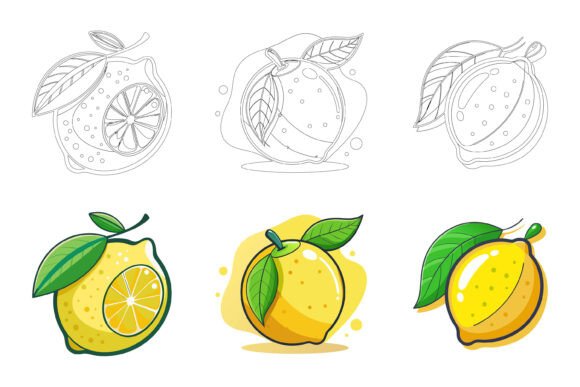
Fresh Lemons: A Designer’s Guide to Using and Choosing the Best AI EPS Illustration Set
Fresh, zesty, and symbolically bursting with energy — lemon illustrations can lift almost any visual project. Whether you’re designing a summer menu, building an organic food brand, or crafting a lifestyle blog post, high-quality lemon graphics bring an instant sense of cleanliness, tanginess, and natural appeal. But not all lemon illustration sets are created equal. The difference between a frustrating clip art experience and a seamless design tool often comes down to what’s inside the file — and how well it’s prepared for real-world work. That’s where a purpose-built Fresh Lemons AI EPS illustration collection changes the game. It’s not just a folder of pretty citrus; it’s an adaptable resource crafted for both beginners and seasoned creatives who want to edit, scale, and customize without friction.
Many people grab the first lemon graphic they find online, then waste hours fixing broken layers, mismatched styles, or unsalvageable low-resolution files. Others buy vector sets assuming they’ll work perfectly, only to discover they can’t change a single slice color without unraveling the whole design. It’s a common and costly oversight. Understanding what makes an illustration set truly “usable” helps you avoid that dive in quality and time — and produce work you’re proud to present. This article walks through practical, field-tested advice on what to check, how to integrate fresh lemon graphics effectively, and why details like file organization and format variety matter much more than they initially seem.
Why Practical Designers Choose Editable Lemon Illustrations Over Stiff Clip Art
A basic mistake many make is reaching for a static JPG or PNG of a lemon and calling it done. While that might work for a one-off social post, it quickly becomes a liability when the project grows. You can’t resize a raster lemon for a large poster without it getting soft and blurry. You can’t easily change the yellow tones to match a brand’s specific palette. And editing out a leaf or adjusting the highlight? Forget it without advanced retouching. That’s why an AI EPS illustration set is the smarter foundation. With vector files, your lemons stay crisp from a website icon to a billboard. More importantly, you can select individual parts — the rind, the pulp, the shadow, each little seed — and modify them independently. This flexibility saves you from redesigning from scratch and keeps your work consistent across print and screen.
For someone creating a health app icon, for instance, a flat, editable lemon shape can be recolored to match dark mode with a couple of clicks. A blogger illustrating a recipe card benefits from being able to scale the same lemon graphic up for a feature image and down for a printable label without losing detail. The key is having a set built with intelligent layering, not a single flattened object. When you open the file and immediately see logical layer names and grouped elements, you know the illustrator designed it with real users in mind.
The Hidden Frustrations of Messy Vector Files (And How the Right Set Prevents Them)
One of the most overlooked aspects of buying an illustration pack is what happens the moment you unzip it. Files that look gorgeous in the preview can be a nightmare to work with if layers are unnamed, objects are embedded weirdly, or the artwork uses excessive anchor points that make editing sluggish. Some free or low-cost lemon sets even combine raster textures inside vector files, limiting true scalability. A poorly structured set leads to wasted time: you start hunting for that one highlight, accidentally ungroup a mess, or find that changing a color affects parts you didn’t intend to alter. In the worst cases, you might assume your software is at fault when the real culprit is a sloppy source file.
A well-prepared Fresh Lemons collection avoids this completely by offering a neatly organized file and layer structure. Every lemon slice, whole fruit, blossom, and leaf lives on its own clearly named layer. Grouping is logical — you can hide all shadows at once, or select just the peel highlights. This kind of organization isn’t just a nice-to-have; it directly impacts your creative efficiency. It also reduces the risk of breaking something when you hand off the file to a teammate or update it months later. Before purchasing any illustration set, check the description carefully for mentions of layer structure and file organization. If a seller proudly details this, it’s usually a sign they understand professional workflows.
Matching Lemon Graphics to Your Project’s Purpose: Common Mismatches
Another frequent misstep is picking a visual style that fights the intended message. A highly realistic, watercolor lemon might be beautiful, but it could look out of place in a minimal tech interface. Conversely, a super simplified, flat vector lemon might feel too cold for a farm-to-table restaurant’s rustic menu. The Fresh Lemons set comes with a consistent style that bridges versatility — detailed enough for print but clean enough for digital screens and infographics. That balanced approach gives you room to use the same asset across multiple channels without it feeling jarring.
Think about context: a lifestyle blogger who uses a whimsical lemon doodle for a “summer detox” post creates a friendly, approachable feel. A marketer creating a price comparison infographic for cleaning products needs something sharper, more iconic. In both cases, consistency in the illustration’s detailing — the uniformity of line thickness, the natural curvature, the subtle shading — makes the graphic feel intentional rather than slapped on. Before downloading any set, ask yourself: Will this style feel coherent on a business card, a mobile screen, and a large-format poster? If the answer is yes without major tweaks, you’ve found a versatile resource.
Print, Web, and App: A Simple Checklist Before You Download
Skipping a quick compatibility check remains one of the easiest ways to derail a project. Not every vector file is instantly usable in every program. The Fresh Lemons collection specifically addresses this by including AI (Adobe Illustrator), EPS (Encapsulated PostScript), and JPG formats, making it friendly for both Mac and Windows users. AI files preserve full editability in Illustrator, while EPS serves as a universal exchange format that can be opened in CorelDRAW, Affinity Designer, or even older software. The included JPGs offer instant previews or quick placement when you don’t need to edit — useful for mockups or internal presentations.
Here are a few crucial points to check before committing to any illustration set:
- Software compatibility: Are you using a program that fully supports AI or EPS layers? Modern tools like Inkscape or Canva handle many formats, but complex Illustrator-specific effects may flatten. Look for “Designed for Mac and Windows” and check the file versions provided.
- Color mode: Print projects usually need CMYK; screen uses RGB. A thoughtful set will include a preview in RGB JPG while the vector remains flexible. Always verify that you can switch color modes smoothly.
- Resolution independence: Vector graphics are, by nature, scalable. But if the set includes JPG thumbnails, confirm they’re large enough for your draft work — at least 2000 pixels on the long side is a safe benchmark.
- License clarity: Know whether you can use the lemons in a product for sale, a logo, or a commercial template. Most professional sets grant broad usage, but it’s wise to review terms.
By running through this mental checklist, you dodge the all-too-common scenario of buying a lovely pack, only to discover it won’t open cleanly in your software of choice. The best suppliers state these details upfront, just as the Fresh Lemons package outlines compatibility and file types clearly.
Customizing Colors and Shapes: Tips for Beginners and Pros
Perhaps the most empowering feature of a vector lemon set is the ability to change colors and modify icons easily. Yet many people hesitate, worried they’ll ruin the artwork or lack the technical skills. A cleverly built set makes it straightforward. If you’ve ever tried to select the rind of a lemon to shift it from bright yellow to a muted, vintage ochre, only to pull half the stem along with it, you know the value of well-grouped elements. The Fresh Lemons collection ensures that each component — from the glossy highlight to the textured pith — is separate and intuitively grouped. You click, recolor, and see the change instantly without affecting the rest of the fruit.
A simple, practical approach: before starting a major redesign, duplicate the artboard or save a copy. Then you can freely experiment. Need a lime instead of a lemon? Adjust the yellow to a green palette and perhaps tweak the shape slightly. Want to create a seamless pattern? Use the individual lemon slices and leaves to build a repeat without inconsistent shadows. For infographic designers, mixing and matching lemon parts into custom icons — like a “wedges of vitamin C” meter — becomes possible when the base elements are intelligently separated. This level of control transforms a static illustration into a building kit. It also means you don’t need to buy five different fruit sets when one adaptable collection can do the work.
What to Look for in an Illustrator’s File Structure
Let’s dig a bit deeper into file structure, because it’s the silent difference between a professional asset and a frustration. When you open a well-crafted AI file, you might see layers named “whole lemon,” “half slice,” “leaf cluster,” “shadows,” and “highlights.” This is a sign of perfection in details and consistency. If instead you see “Layer 1” with 300 unnamed paths, you’ll quickly lose time. The Fresh Lemons set emphasizes neat organization, which directly translates to faster workflows. For a freelancer billing by the hour, that time saved is money earned.
Another overlooked gem: consistency across all assets in the set. If one lemon slice has thin, delicate lines and another looks bolder and heavier, your design will look mismatched. The best sets are drawn with a unified visual language — same stroke weights, same lighting direction, same level of detail. This attention to detail means you can place multiple lemon graphics on the same page without them feeling like they came from different sources. It’s a small thing that subconsciously communicates quality to your audience. Before buying, zoom in on the preview images. Look at the leaves, the texture of the peel, the seeds. Are they all treated with equal care? If yes, you’ve found a reliable resource.
Examples of Smart Lemon Graphic Integration
Seeing real-world applications clarifies how a versatile lemon illustration set fits into daily work. Imagine a small business owner creating a summer promotion: she needs lemon visuals for a storefront banner, an email header, and social media stories. With a single AI EPS set, she designs the large banner at 300 DPI in CMYK, uses the same lemon icon recoloured slightly for the digital banner in RGB, and exports a crisp, small-sized version for Instagram. No re-creation, no loss of quality. Another example: an educator preparing a vitamin-rich nutrition infographic for a classroom poster. He pulls citrus cross-sections, adjusts the colors to be print-friendly, and labels each part with clear typography — all because the layers let him hide and show details as needed without starting over.
Bloggers and content creators benefit too. Rather than relying on stock photography that might clash with their site’s palette, they can color-match a lemon wedge to their brand highlight color and use it as a recurring motif across their blog. The suitability for print, web, symbols, apps, and infographics isn’t just marketing fluff; it means the same file gracefully handles a 100-pixel app icon and a 24-inch printed sign. The peace of mind that comes from knowing you can reuse and adapt one set for endless projects is hard to overstate.
Making a Confident Choice with Fresh Lemons
When you’re evaluating any illustration pack, pay attention to the three pillars: editable vector format with sensible layering, cross-platform file delivery (like AI, EPS, and JPG), and visual consistency. The Fresh Lemons collection hits all these marks while keeping the artwork detailed yet practical. It avoids the classic pitfalls of messy files, inflexible color usage, and style mismatches that plague so many lesser offerings. The moment you open the file and see the organized structure, you’ll understand how it cuts out the guesswork and lets you focus on the creative part of your project instead of technical repairs.
Whether you’re a beginner looking for your first vector pack or a seasoned designer tired of fixing other people’s sloppy artwork, this is the kind of resource that raises the quality of your output without demanding heroic effort. The lemons themselves — vibrant, well-proportioned, and naturally charming — become a quiet asset that elevates menus, eco-branding, educational materials, and much more. And because you can tweak every color and element, each piece can be uniquely yours while still carrying the polish of professional illustration. Keep the checklist in mind, test a file if you can, and trust only those sets that respect your time as much as your design vision. With the right lemon illustration set in your toolkit, you’ll create fresher, more cohesive visuals every time.